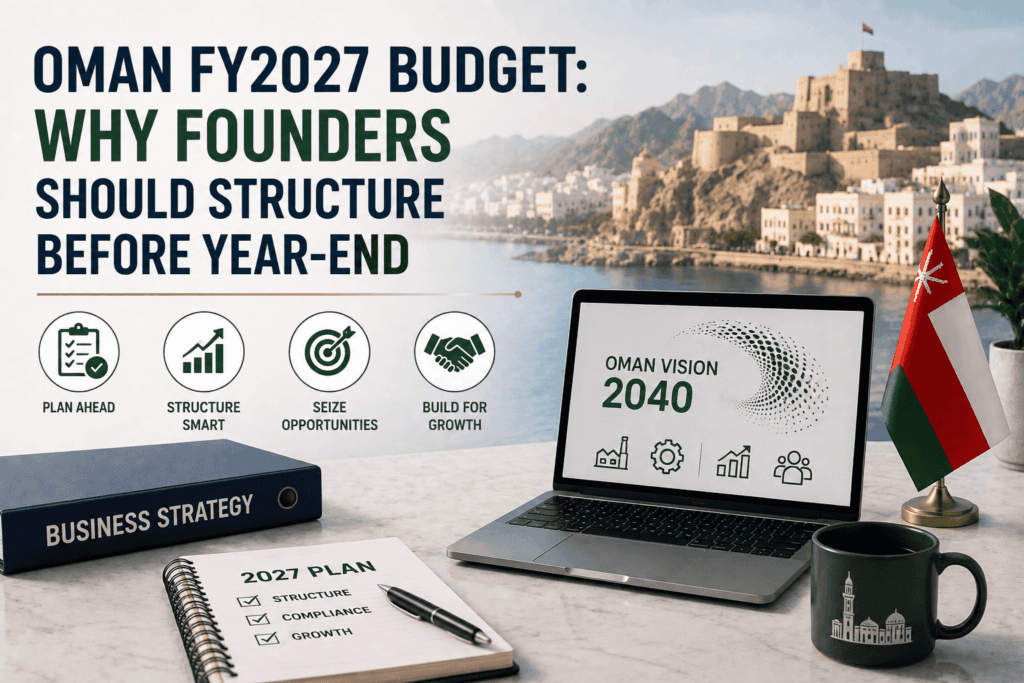
Oman FY2027 Budget: Why Founders Should Structure Before Year-End
Is your Oman business ready to begin operating in 2027, or are key decisions about ownership, licensing, banking, and staffing still pending?
Founders do not need to predict future fee or tax changes to begin preparing. Business setup involves several connected decisions, and delays in one area can affect the entire launch schedule.
Oman’s FY2027 budget will form part of the Eleventh Five-Year Development Plan covering 2026 to 2030. Foreign investors should therefore use the remaining months of 2026 to review their proposed activities, legal structure, approval requirements, and market-entry timeline.
At Jitendra Consulting Group, we help entrepreneurs and corporate investors prepare these elements before beginning the formal company formation process.
What FY2027 Means Within Oman’s Development Plan
Oman’s Eleventh Five-Year Development Plan is the second implementation roadmap for Oman Vision 2040. It covers the period from 2026 to 2030 and sets priorities related to economic diversification, investment, private-sector participation, employment, sustainability, and regional development.
The first work programme under the plan covers 2026 and 2027. This means FY2027 is not an isolated financial year. It is part of a wider implementation period in which government projects, sector programmes, and investment priorities are expected to continue developing.
This does not mean that incorporation fees, licence charges, taxes, or visa costs will necessarily increase. Any such change should only be discussed once officially announced.
For founders, the more relevant point is that Oman has already defined its wider economic direction. Businesses can use this information to make informed structuring and investment decisions.
Why Founders Should Prepare Before the Budget Announcement
The case for early preparation is based on operational readiness, not speculation about future charges.
A company that has already selected its legal form, confirmed its commercial activities, and identified the necessary approvals may be better prepared to respond to new investment programmes, projects, tenders, or sector initiatives introduced during 2027.
Founders who wait until every budget detail is published may still need to complete several preliminary steps, including:
- Selecting the correct commercial activities
- Comparing mainland, free zone, and special economic zone options
- Confirming foreign ownership requirements
- Preparing shareholder and beneficial ownership documents
- Identifying sector-specific approvals
- Arranging premises or a registered business address
- Planning banking, visas, recruitment, and payroll
- Reviewing accounting and tax registration obligations
Completing these decisions before year-end does not require founders to make assumptions about government policy. It simply helps prevent the company setup process from beginning too late.
Early Structuring Does Not Mean Rushing Incorporation
Setting up before year-end should not be treated as a race to obtain a commercial registration.
A company may be registered quickly and still face operational problems if its ownership, activities, licensing pathway, or business model have not been reviewed correctly.
For example, a founder may select an activity that does not fully cover the services the company intends to provide. Another investor may complete registration without confirming whether an additional sector approval is required.
Early structuring gives founders time to answer these questions before submitting applications.
It also helps distinguish between two important stages:
- Business structuring:Deciding how the company should be owned, licensed, funded, managed, and operated.
- Company formation:Filing the documents and completing registration with the relevant authorities.
Starting the structuring stage before year-end can make the formation process more organised, even when commercial operations are planned for 2027.
Sectors Receiving Attention Under the 2026–2030 Plan
Oman’s development plan identifies manufacturing, tourism, and the digital economy as important sectors. Supporting areas include mining, food security, renewable energy, transport and logistics, education, and healthcare.
The plan also aims to strengthen entrepreneurship, attract private investment, support exports, create employment opportunities, and increase economic activity across Oman’s governorates.
Businesses entering these sectors may need to review additional requirements beyond general company registration, such as:
- Industrial land or facility requirements
- Environmental and municipal approvals
- Import and customs arrangements
- Technical or professional licences
- Tourism or hospitality permissions
- Healthcare, education, or food-sector approvals
- Technology, data, and cybersecurity requirements
- Workforce classification and Omanisation planning
Reviewing these requirements early can help founders choose a structure that supports their intended operations.
What Founders Should Complete Before Year-End
Founders may not need to complete the entire incorporation process before 31 December. However, they should aim to finalise the main structuring decisions.
Confirm the commercial activity
The selected activity should accurately reflect the company’s proposed products and services. Founders should also check whether external regulatory approval is required.
Select the appropriate jurisdiction
The choice between mainland Oman, a free zone, or a special economic zone should consider customers, office or warehouse requirements, imports, workforce needs, and geographical reach.
Finalise the ownership structure
Individual shareholders, overseas parent companies, joint ventures, and group entities may require different documentation and governance arrangements.
Prepare foreign documents
Documents issued outside Oman may require notarisation, legalisation, attestation, or certified translation. Delaying these steps can affect the launch schedule.
Build the operational timeline
The setup plan should include registration, licensing, premises, banking, tax registration, visas, recruitment, and additional sector approvals.
Does Early Incorporation Protect a Company From Future Changes?
Registering before year-end does not permanently protect a business from future laws, taxes, government charges, renewal requirements, or compliance obligations.
A company formed in 2026 may still need to comply with rules introduced or amended in 2027. Therefore, the benefit of early structuring is not guaranteed cost protection.
The real benefit is preparedness.
Founders gain time to compare options, correct documentation gaps, review compliance obligations, and prepare for commercial activity. They can enter 2027 with a defined structure instead of beginning every decision after the annual budget is released.
How Jitendra Consulting Group Supports Oman Market Entry
The Oman FY2027 budget should be viewed as part of a wider economic planning cycle, not as evidence that business setup costs will automatically increase.
At Jitendra Consulting Group, we help foreign entrepreneurs, SMEs, and corporate groups evaluate their Oman market-entry options before filing an application. Our support includes activity assessment, legal structure review, jurisdiction comparison, documentation planning, licensing coordination, and business setup consultancy.
By beginning the structuring process before year-end, founders can enter 2027 with clearer decisions, prepared documents, and an implementation plan aligned with their commercial goals.
Planning to establish or expand a business in Oman? Contact Jitendra Consulting Group to review your proposed structure and prepare your company formation pathway for 2027.