
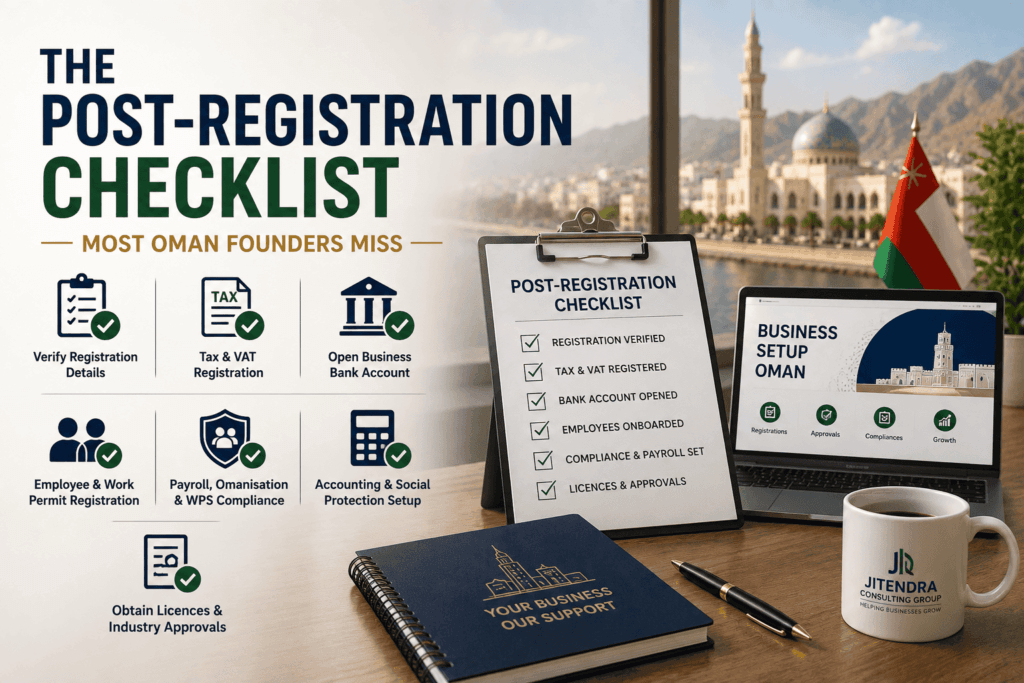
The Post-Registration Checklist Most Oman Founders Miss
Have you completed registration but still cannot open an account, hire staff, issue invoices, or start trading? Many founders expect the registration certificate to finish the process. Then banks, tax officers, landlords, or labour authorities ask for more records. A planned follow-up removes these delays.
We at Jitendra Consulting Group help founders organise each requirement in the right order.
Check Commercial Registration Details and Business Activities
Check the legal name, registered address, activity codes, ownership details, and authorised signatories. Every item should match the company’s work. A mismatch may delay banking, tax registration, lease approval, or employee processing.
The business platform expanded its data-correction and ownership-transfer services. During Q1 2026, investors completed 38,551 self-service transactions, while cumulative self-service transactions reached 1.16 million.
A business registration checklist for Oman should also cover portal access, mobile numbers, email addresses, shareholder records, and document expiry dates. Keep one folder for corporate papers. Review the business registration checklist for Oman whenever ownership, location, or activities change.
Complete Corporate Tax and VAT Registration After Company Formation
The standard corporate income tax rate for Omani companies and permanent establishments is 15% of taxable income. However, certain qualifying SMEs may be eligible for a 3% tax rate, subject to the conditions prescribed under the Income Tax Law. Therefore, founders should record income, expenses, contracts, invoices, and bank movements from the start.
Tax registration for companies in Oman needs matching commercial and contact details. It also needs a responsible person to monitor notices and filing dates. In addition, tax registration for companies in Oman should cover VAT duties, invoice wording, record storage, and expected turnover.
Open a Business Bank Account and Submit the Required Documents
Banks assess the business model, ownership, expected payments, and source of funds. Prepare one file before applying for corporate bank account setup in Oman. It may include:
- Commercial registration and formation papers
- Shareholder and signatory identification
- Office lease and contact records
- Contracts, business plan, and expected turnover
- Ownership structure and source-of-funds evidence
Corporate bank account setup in Oman can slow down when names, addresses, activities, or signatures differ across documents. Compare each paper against the registration record. Explain customers, suppliers, payment countries, and expected transaction size.
Register Employees, Labour Contracts and Work Permits in Oman
Hiring needs coordination between the job offer, labour contract, visa, work permit, salary, and occupation. These details should match from the start. Otherwise, the employer may face delays during onboarding, payroll registration, or renewal.
Before offering a role, check whether the registered activity supports that job. Also, confirm whether the position allows expatriate recruitment. The post-incorporation requirements in Oman include valid employee records, approved contracts, correct work permits, and updated employer information. Keep one file for every worker, including identification, approvals, salary terms, and renewal dates.
Meet Omanisation, Payroll and Wage Protection System Requirements
Workforce planning should begin before recruitment. Omanisation duties may vary by sector, activity, and occupation. Therefore, founders should review the required local employment level before making staffing promises.
Payroll also needs monthly checks. Salary records should match employment contracts and bank transfers. Any difference may create questions later. The post-incorporation requirements in Oman also include payroll evidence, employee data, and labour records. Assign one person to compare contracts, attendance, leave, salary amounts, and payment dates before payroll.
Set Up Accounting, Bookkeeping and Social Protection Records
Late bookkeeping creates missing invoices, unclear expenses, and weak bank records. Choose an accounting process early. Number every invoice, save purchase documents, record owner payments, and separate business spending from personal spending.
The company should keep payroll and social protection records aligned with employee details. Monthly reviews support tax filings, bank requests, and licence renewals. A small company needs regular entries, proper document storage, and named responsibility for each finance task.
Obtain Municipal Licences and Industry-Specific Business Approvals
Commercial registration may not allow immediate trading in every sector. Some activities need municipal approval, premises clearance, product certificates, professional permits, or consent from a sector regulator. Check these requirements before signing a lease, importing goods, or serving customers.
There is no official programme formally called “The 7-Day Launch” in Oman. However, fast-track company formation within about five to seven days may be available when founders prepare documents early and use streamlined services. That timeline covers formation, not every later approval.
Track Commercial Licence Renewals and Oman E-Invoicing Deadlines
Create one calendar for tax filings, labour permits, lease dates, portal notices, e-invoicing work, and business licence renewal in Oman. Give every deadline an owner. Add reminders before the final date.
Business licence renewal in Oman may depend on updated records, active permits, and supporting documents. Meanwhile, e-invoicing preparation may require invoice fields, customer data, software checks, and staff training. Review these items during the year. A missed renewal can interrupt banking, staffing, contracts, or customer billing.
What Support Does Jitendra Consulting Group Offer After Company Registration?
Registration creates the legal company, but follow-up work makes it ready to operate. Our advisers support foreign entrepreneurs, SMEs, and corporate investors with document reviews, small business setup services, bank preparation, tax coordination, labour files, approval tracking, and renewal planning.
We help founders place each task in the correct order. We also check whether records match across authorities and service providers. This support reduces repeat visits, missing papers, and delays. Founders can focus on customers and operations while we guide the remaining setup work.