
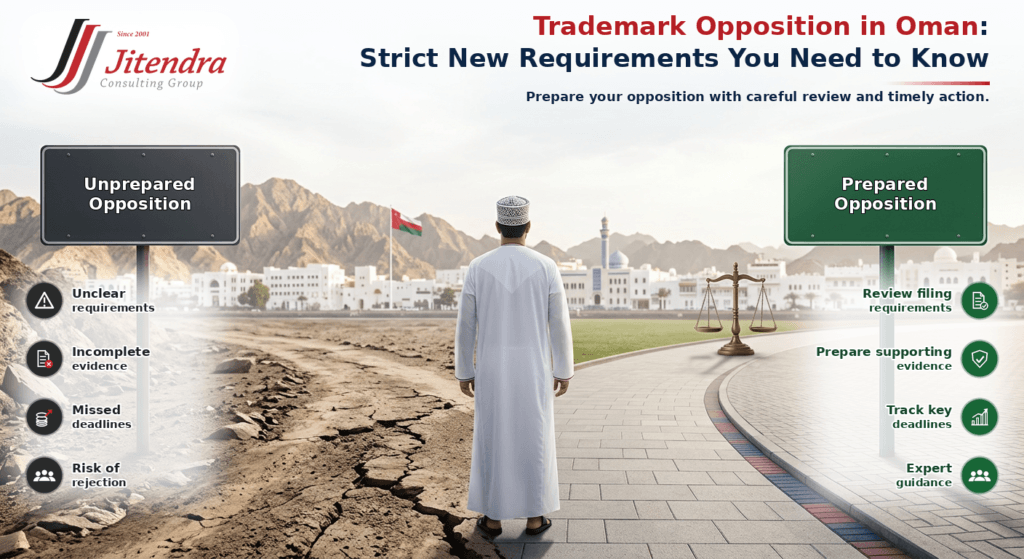
Trademark Opposition in Oman: Strict New Requirements You Need to Know
Trademark opposition in Oman has become subject to stricter requirements following recent procedural updates reported from the trademarks Office. These focus on the opponent’s legal standing, the relationship between the contested mark and the earlier rights relied upon, and the match between the goods and services concerned. Similarity of name or logo alone is no longer enough to ensure that an opposition is accepted or succeeds.
These developments matter to trademark owners and companies seeking to protect their brand identity against similar or conflicting registrations. An opposition that fails to meet the requirements may be refused, even if the owner believes the published application threatens its commercial interests.
Opposing trademark Registrations in the Sultanate of Oman
Trademark opposition is a legal procedure that allows rights holders to oppose a published trademark application where they consider that its registration may affect their rights or conflict with a mark they own or an application they have previously filed.
Opposition is an important means of protecting trademarks, as it allows rights holders to object before the registration of the contested mark is completed.
However, the admissibility and outcome of an opposition depend not only on filing within the prescribed time limit but also on the opponent meeting the necessary legal and procedural requirements and on the strength of the evidence supporting its case.
New Requirements for Trademark Opposition in Oman
According to the reported procedural updates concerning the Omani Trademarks Office, stricter requirements now apply to the opponent’s legal standing, the basis of the opposition, and the relationship between the goods or services of the two marks, as follows:
1. A registered mark or pending application in Oman
One of the reported procedural requirements is that the opponent must own a trademark registered in the Sultanate of Oman or have a pending application in the same class as the published mark being opposed.
Under this policy, owning a registration in another country or proving use of a mark outside Oman is not enough on its own to establish standing to oppose. The rights holder must have a local legal basis on which to rely before the Trademark Office.
This is particularly important for international companies that own well-known marks in several markets but have not yet applied to register them in the Sultanate. Such companies may need to review the position of their marks in Oman before conflicting applications appear.
2. International reputation alone is not enough
The updates indicate that, under the new procedural policy as described, the international reputation of a mark is no longer sufficient on its own to form the sole basis for a valid opposition.
A company that owns a globally well-known mark may therefore struggle to oppose a mark published in Oman if it has no local registration or pending application that satisfies the standing requirements.
That said, the procedural requirement of standing to oppose should be distinguished from the legal protection that well-known marks may enjoy under the legislation in force. This update should not be treated as a general removal of protection for well-known marks without consulting the legal text or the official circular that defines its scope.
3. The goods or services must match
Registration of both marks in the same class does not guarantee that an opposition will succeed. The updates indicate that the opposition committee also examines the specific goods and services listed in each application and the extent to which they match or are actually related.
A single class may cover goods or services that differ in nature and use, so similarity in class number alone does not establish a conflict between the marks.
According to the reported policy, an opposition may be rejected where the specified goods or services differ, even if the marks are partially similar in sound or appearance. The conflicting application may then proceed to registration based on that difference.
The description of the goods and services should therefore be reviewed carefully before filing an opposition, and the class number should not be treated as sufficient evidence of conflict.
Jitendra Trademark and Patent Services SPC supports you in reviewing your trade mark’s status, the opposition requirements and the latest conditions, helping ensure that your application is prepared in accordance with the applicable rules and procedures.
Why Similarity Between Marks No Longer Guarantees a Successful Opposition
Assessing a conflict between trademarks depends on several factors, not merely similarity of names or logos. The most important are the nature of the goods or services the marks distinguish, how closely they are related, and the likelihood of confusion among consumers.
For example, two marks may contain similar words or visual elements but be used in different businesses with no meaningful connection. Conversely, similarity between two marks used on closely related goods may increase the likelihood of confusion as to their commercial origin.
An opposition file should therefore include a clear analysis of the relationship between the two marks and their respective goods and services, together with documents proving the right on which the opponent relies.
How to Prepare to Oppose a Trademark in Oman
If you find a published application that you believe conflicts with your trademark, assess your legal position before filing. You can follow these steps:
- Review your mark’s status in Oman: check whether you hold a local registration or a pending application, and whether it covers the relevant class and goods or services.
- Examine the published mark: review the name, logo, and distinctive elements of the contested application, and do not rely on a comparison of the marks’ names alone.
- Compare the goods and services: examine the detailed specification in both applications and identify where they match or are related.
- Prepare evidence and documents: gather the registration certificate or local application details, documents supporting the conflict, and any other relevant evidence.
- Review the legal position: confirm that the standing, time limit and procedural requirements are met before filing, as a substantive ground for opposition does not necessarily make up for missing procedural requirements.
Why File a Local Application Before Conflicting Marks Appear?
Delay in registering a trademark in Oman may reduce the owner’s chance to act when a similar application is published, particularly where the procedural policy requires a local registration or pending application to establish standing.
Companies planning to enter the Omani market should therefore not wait for a competing mark to appear before considering protection. It is better to review the intellectual property portfolio, identify the classes, goods and services that need protection, and then consider the timing of local filings.
It should also be noted that filing a new application does not automatically guarantee the success of any later opposition. The relevant standing and goods-matching requirements must be met, and the approved procedures and deadlines observed.
How Can Jitendra Trademark and Patent Services SPC Help Protect Your Trademark in Oman?
Opposing trademarks in Oman requires careful review of registered rights and pending applications, analysis of the goods and services, and an understanding of the procedures applied by the Trademark Office.
Jitendra Trademark and Patent Services SPC supports companies and trademark owners by reviewing the status of their marks, examining relevant applications, determining the appropriate classes, preparing the necessary documents, and assisting with trademark registration and opposition proceedings, within the agreed scope of service.
Whether you plan to register a new trademark in Oman or wish to assess your position against a published mark that may conflict with your rights, an early review of your file helps you take clearer steps to protect your commercial interests.
Under the new updates, international reputation alone does not establish the standing required to oppose. A local registration or pending application in Oman that meets the relevant conditions may be required.
No, being in the same class does not guarantee success. The specific goods or services in each application, and the extent to which they match or are related, must be examined.
The new policy as described requires a registered mark or pending application in Oman in the relevant class. The local legal position should therefore be verified before filing an opposition.
Not necessarily. Similarity is assessed alongside the nature of the goods and services and the likelihood of consumer confusion, as well as the opponent’s compliance with the procedural requirements.
Early registration establishes local rights that can be relied on to protect the mark and to take appropriate action when conflicting applications appear, subject to the legal and procedural conditions in force.